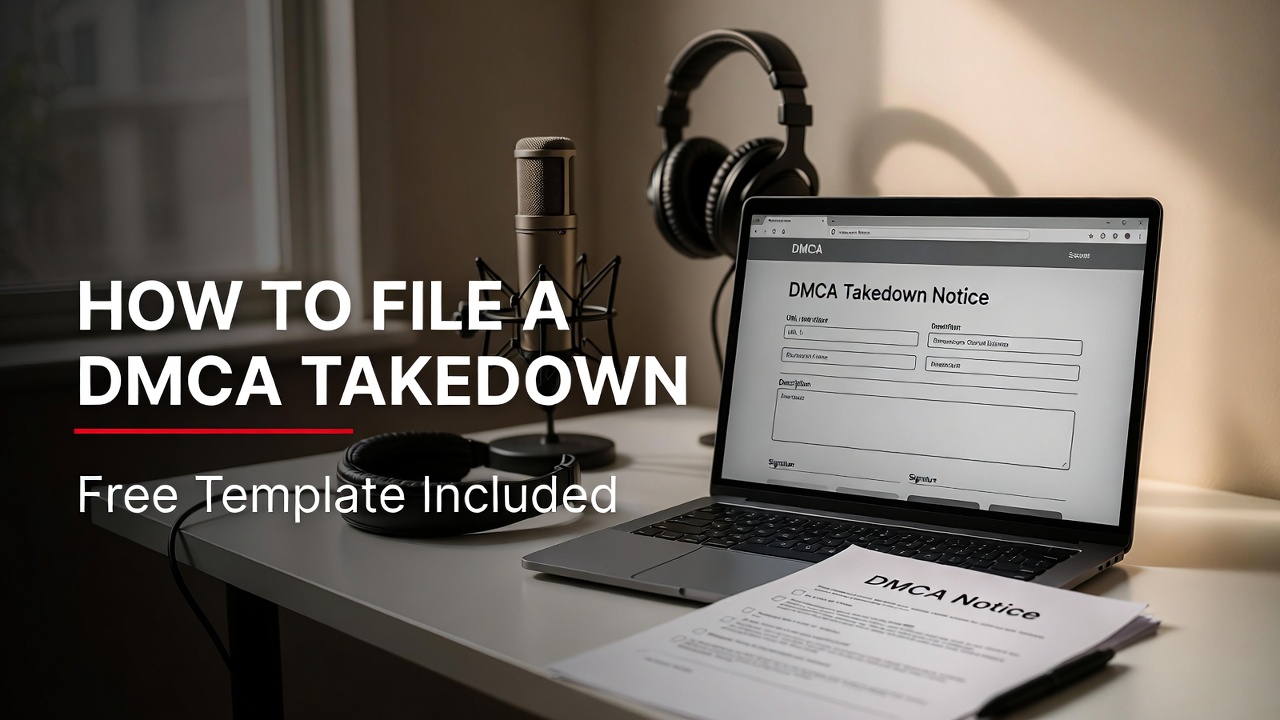
(Free Template Included)
If someone uploaded your music without permission, you don’t have to argue in comments or send angry DMs. U.S. copyright law gives you a formal, powerful removal process.
This guide explains exactly how to file a DMCA takedown notice, when it applies, and what happens after you submit it. A free copy-paste template is included below.
What Is a DMCA Takedown?
A DMCA takedown is a formal removal request under the Digital Millennium Copyright Act.
It allows copyright owners to demand removal of infringing content from platforms like:
- YouTube
- Spotify
- TikTok
- SoundCloud
- Website hosts
Online platforms must comply with valid takedown requests to maintain their “safe harbor” legal protection.
What Qualifies as Copyright Infringement?
Before filing, confirm the use actually qualifies.
✅ Valid Infringement Examples
- Someone re-uploaded your entire song
- A distributor released your track under their name
- Your beat was uploaded without license
- Your music is monetized by someone else
- A website is offering your song as a free download
⚠️ Not Automatically Infringement
- Fair use (criticism, commentary, parody)
- Very short clips in some contexts
- Licensed usage
- Public domain works
If you’re unsure, consult a copyright attorney before filing.
Step-by-Step: How to File a DMCA Takedown
Step 1: Gather Proof of Ownership
You should have:
- Original audio file (with metadata if possible)
- Registration certificate (if filed)
- Publishing agreement (if applicable)
- Distribution proof
- Links to original upload
While registration is not required to file a DMCA notice, it strengthens your claim.
Step 2: Locate the Platform’s DMCA Form
Most major platforms provide an online copyright complaint form.
For example:
- YouTube → Copyright Removal Form
- Spotify → Content infringement portal
- Web hosts → DMCA agent email listed in Terms
Search:
“[Platform Name] DMCA takedown form”
Always use the official website.
Step 3: Include Required Legal Information
Under the Digital Millennium Copyright Act, your notice must include:
- Your legal name and contact information
- Identification of the copyrighted work
- Exact URL of infringing material
- Statement of good faith belief
- Statement under penalty of perjury
- Your electronic signature
If any required element is missing, the platform may reject your request.
Free DMCA Takedown Email Template (Copy & Paste)
You can send this to a website host or platform that accepts email notices.
Subject: DMCA Takedown Notice – Copyright Infringement
Body:
To Whom It May Concern,
I am the owner of the copyrighted musical work described below. I have a good faith belief that the material identified is not authorized by me, my agent, or the law.
Original Work:
Title: [Your Song Title]
Created on: [Date]Infringing Material:
URL(s): [Paste Direct Links]I request that you remove or disable access to this material immediately.
I declare under penalty of perjury that the information in this notification is accurate and that I am the copyright owner or authorized to act on behalf of the owner.
Name: [Your Full Legal Name]
Address: [Your Address]
Email: [Your Email]
Phone: [Optional]Electronic Signature: [Type Full Name]
You can save this template and reuse it whenever necessary.
What Happens After You File?
1. Platform Reviews Your Claim
Most platforms respond within 24–72 hours.
2. Content Is Removed or Disabled
If valid, the content will be taken down.
3. Alleged Infringer Is Notified
They receive a copy of your complaint.
4. Counter-Notification Option
The accused party may file a counter-notice claiming legal right.
If that happens, you may need to file a lawsuit within 10–14 business days to keep the content offline.
What If the Content Is on Spotify?
If someone distributed your music through a fake distributor:
- Report directly through Spotify’s infringement form
- Contact your distributor (DistroKid, TuneCore, etc.)
- Consider escalating through a copyright attorney
Streaming services take fraudulent releases seriously.
Important Legal Warnings
⚠️ Filing a false DMCA claim can result in legal liability.
⚠️ Never file out of revenge or without ownership proof.
⚠️ Always verify you own the copyright—not just a performance right.
Should You Hire a Lawyer?
You may want legal help if:
- The infringement is generating large revenue
- A label or company is involved
- The infringer files a counter-notice
- The situation escalates to litigation
Law firms and legal software services often assist with large-scale enforcement.
Bonus: Downloadable DMCA Template (Increase Page Engagement)
Offer a downloadable PDF version of the template with:
- Editable fields
- Filing checklist
- Required legal language pre-filled
This increases time on page and gives readers something actionable.
Frequently Asked Questions
Do I need to register my music before filing a DMCA?
No. Registration is not required to file a takedown notice.
However, it becomes important if you later sue for damages.
How long does a DMCA takedown take?
Most major platforms respond within 1–3 business days.
Can someone fight back?
Yes. They can file a counter-notice claiming lawful use.
If that happens, you may need to take legal action to maintain removal.
Is a DMCA notice permanent?
Not always. If no counter-notice is filed, removal usually remains.
If a counter-notice is filed and no lawsuit follows, content may be restored.
Final Thoughts
The Digital Millennium Copyright Act gives musicians real power to protect their work online.
If your music has been stolen, act quickly:
- Gather proof
- Submit a proper notice
- Monitor the response
- Escalate if necessary
Using the free template above, you can file a professional DMCA takedown in minutes.